|
|
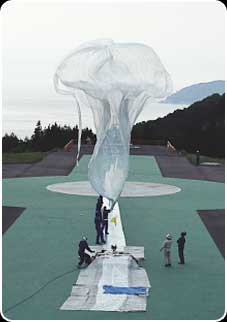
The Scientific Balloon
Center of the Institute of Space and Astronautical Science carries out scientific
space observations and space engineering experiments using balloons. The location
for releasing the balloons is Sanriku, Ofunato, Iwate, which is very famous for
its beautiful coastline.
Scientific balloons can carry observation equipments with weight ranging from
several hundred kilograms to several tones and ascend to altitudes of 30 to 50
kilometers - three to five times higher than passenger jets. These balloons allow
us to observe cosmic radiation - cosmic rays, ultraviolet radiation, infrared
radiation, X-rays, and gamma rays - which is blocked by Earth's atmosphere and
cannot be observed from the ground. It is also possible to collect data on the
direct causes of global environmental changes (e.g. the ozone hole, acid rain,
global warming), and observe precise annual changes. Thus, balloon observations
have been playing an important role in maintaining the integrity of our environment.
Balloons have an altitude limit much lower than that of satellites and rockets,
but they are less expensive and can travel for much longer periods than rockets
- for dozens or sometimes hundreds of hours. Since quick preparation of a balloon
experiment is also possible, it can be equipped with the latest observation instruments.
And since all the observation equipments are recovered and reused, we can confirm
observations by repeating flights.
Balloon experiments can be done in a wide range of altitudes, from the troposphere,
to the stratosphere, to the mesosphere. The Scientific Balloon Center holds the
world record for the highest altitude in a balloon flight - 53 km.
Today, in our space-engineering experiments, we are testing new technologies for
the next generation of balloons. We are studying ways to fulfill our dreams of
making balloons that can fly as high as 60 km, or even higher, for finding out
more about space weather, which can make flight more than 100 days and be able
to circle the globe, and even balloons that can fly in planets.
MORE >> |
|
|
 |
|
|
|
|